


“I’d like to book an appointment with an allergist in Toruń, ideally next week after four in the afternoon, but not on Thursday.”
This is how a person calling a reception desk might speak. One sentence, and within it six conditions: specialisation, city, date range counted from today, time range, an excluded day and (by default) the wish to receive a proposed appointment time. We talked about this very sentence at one of the conferences, because it illustrates perfectly where appointment-booking voicebots can really prove their worth.
This is almost never just about the language model.
How does it work in short? An appointment-booking voicebot is a phone bot that answers the call, converts the customer’s speech into text, extracts the conditions from it (who, where, when), queries the booking system and responds by voice, proposing a specific appointment time. Speech recognition technology and language models are available to everyone today. What determines whether the customer books the appointment or hangs up is how the conversation itself has been designed. Below are the principles that work well in practice.
1. Don’t interrogate the customer – let them say everything at once
The most common mistake is a bot designed as if it were reading out a form aloud:
“Which specialisation?” → “Which city?” → “Which day?” → “What time?”
Four questions mean four exchanges, i.e. a full minute of conversation before the bot even starts searching. And the customer already knows what they want anyway.
It’s better to ask one open question that encourages a full answer:
“Please tell me which doctor you’d like to see, in which town, and what time would suit you best.”
This way, we get most of the conditions in a single sentence. The bot then asks follow-up questions only about what’s specifically missing (“Would you prefer morning or afternoon?”), rather than asking generally (“Please provide a time”).
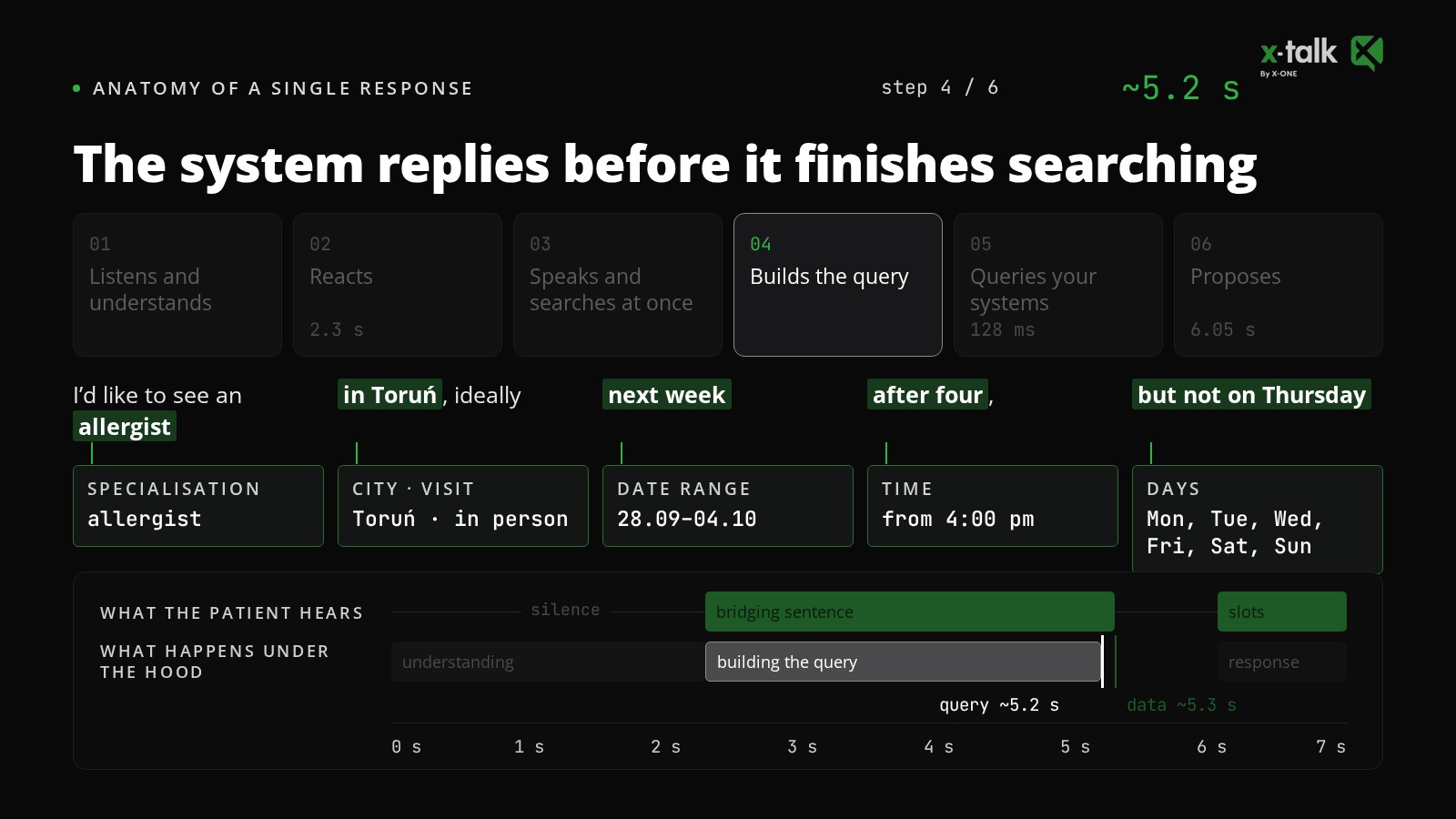
Principle: the question should prompt a full sentence, and the bot should be able to break that sentence down into conditions. The dialogue then isn’t a list of fields to fill in, but a search for a solution together with the customer.
You can read more about how to phrase a bot’s questions directly on the blog of X-TALK, our AI Communication Centre, in the article How to train a voicebot so its questions don’t irritate customers?
2. Before the bot replies, it’s already searching
It must be said that in a conversation with AI, the pause between the end of the customer’s statement and the bot’s reply tends to be slightly longer than in a conversation with a human. The bot has to be sure the customer has finished speaking and understand the whole sentence. If, after that pause, it then had to search the calendar in silence as well, the conversation would start to drag.
That’s why a well-designed bot immediately confirms what it has understood and announces what it’s doing:
“Right, an allergist in Toruń, next week after four in the afternoon, not on Thursday. Let me check the best available time for you now…”
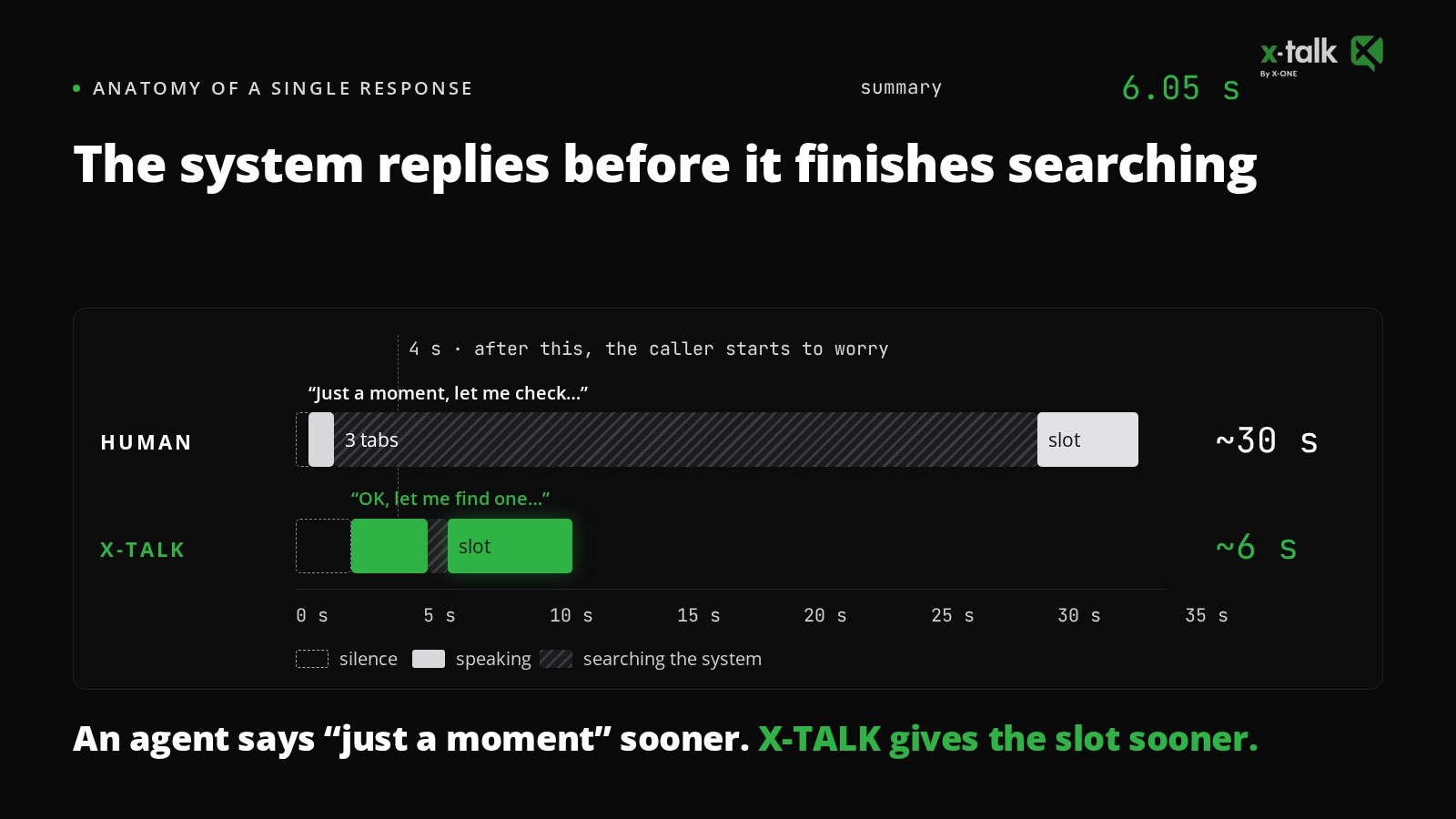
Such a sentence takes care of three things at once. The customer feels heard and can immediately correct the mistake. The conversation doesn’t go quiet. And most importantly, the search is already running in the background: the bot has queried the booking system before it even finishes speaking. By the time it finishes the sentence, the suggestions are usually ready and are given back almost instantly.
The effect is interesting. The bot’s first reaction is slightly slower than a human’s, but the whole case takes less time overall. Meanwhile, the agent is still clicking through the calendar, saying “just a moment, let me check.” Getting the timing of speech and background queries exactly right, so it sounds natural, is a matter of the architecture and fine-tuning of the specific implementation.
3. No available slot must not end the conversation
The second trap: the bot checks exactly what it was asked to check and finds nothing.
❌ “There are no available slots on Tuesday.”
✅ “I don’t have anything after 4 pm on Tuesday, but there’s an available slot with Dr Nowak on Wednesday at 4:30 pm. Would that work for you?”
An agent on a helpline does this instinctively: if exactly what the customer is asking for isn’t available, they suggest something similar. The bot has to do the same, but following a set order:
- the next day (Wednesday instead of Tuesday),
- a wider time range (3:30 pm instead of “after 4 pm”),
- a different specialist in the same field,
- a nearby branch (“not in Toruń, but tomorrow in Bydgoszcz”),
- the nearest available slot as a last suggestion.

It’s important, in a voice conversation, to offer two, or at most three options, not ten. A person on the phone won’t remember a long list. When the customer rejects a suggestion (“no, Wednesday doesn’t work either”), that’s not a failure — it’s simply another condition that narrows down the search.
4. The customer changes their mind mid-conversation – that’s normal
“…actually, no, not Thursday after all.” People correct themselves mid-sentence and interrupt the bot when they hear something that doesn’t suit them. A good voicebot:
- allows itself to be interrupted and stops speaking immediately,
- treats the correction as a new condition, not as a new conversation,
- doesn’t make the customer start over from the beginning.
Balance is key here. A bot that lets itself be interrupted too easily also reacts to background noise or a cough. A bot that decides too early that the customer has finished speaking cuts them off during a natural pause. Settings always depend on the channel and acoustics: a phone call behaves differently in a quiet office than in a shop during rush hour.
5. Booking systems are designed for searching, not negotiating
This is where the engineering begins. A human provides six or seven conditions. A typical booking system API accepts three fields: city, day, specialisation. All required, no ranges.
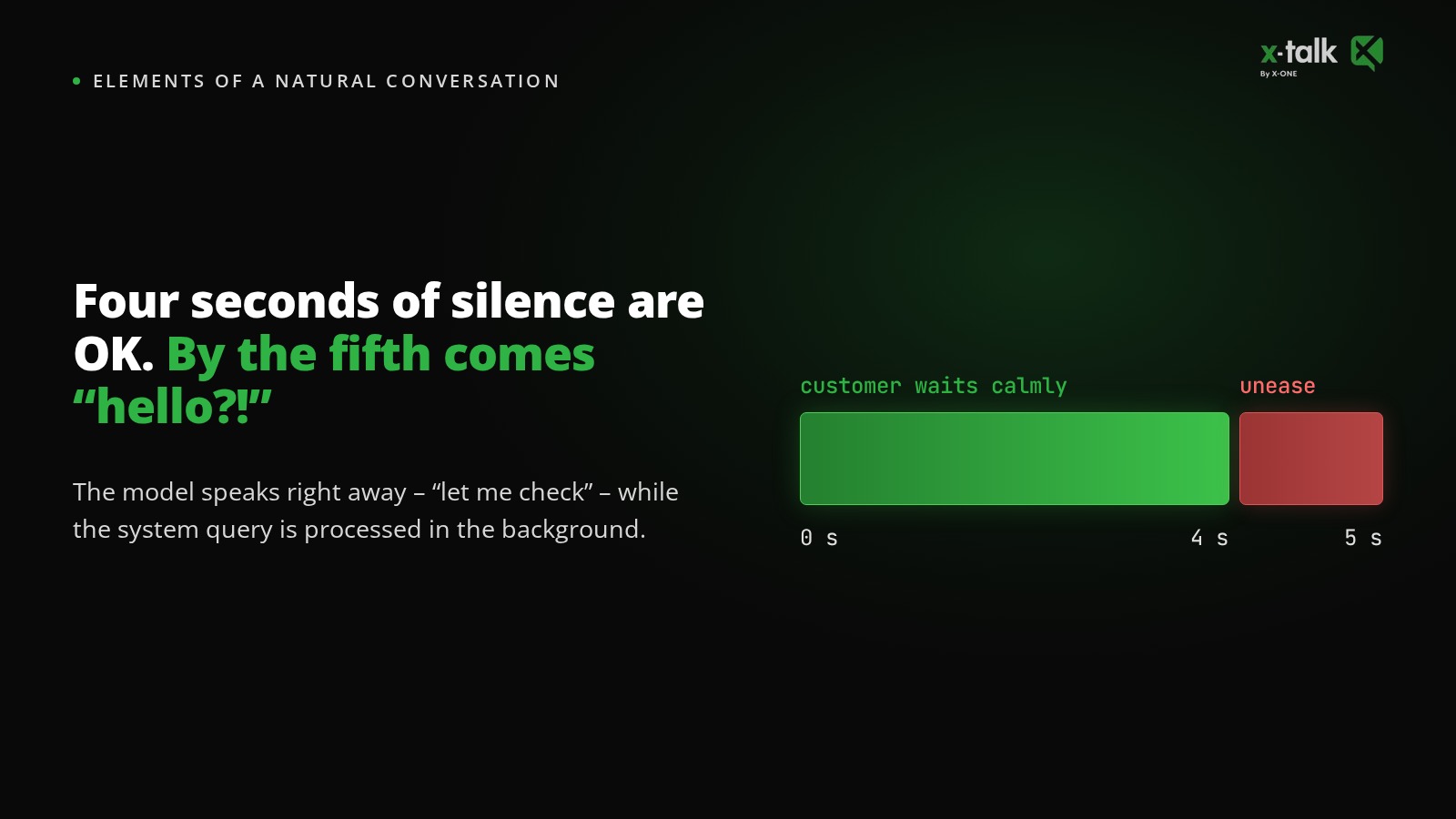
In practice, this means the bot has to translate one customer sentence into multiple queries (one for each day within the range), retrieve the results, and then independently filter out times and excluded days and select the best matching slot. All within the time it takes the bot to say a confirmation sentence, before the customer becomes impatient. 4 seconds of silence is enough for the caller to start wondering whether the bot has heard them, and by the 5th second they’ll already be saying “hello?”.
The conclusion for anyone designing a booking system or a bot integration:
Design the API for negotiation, not for searching.
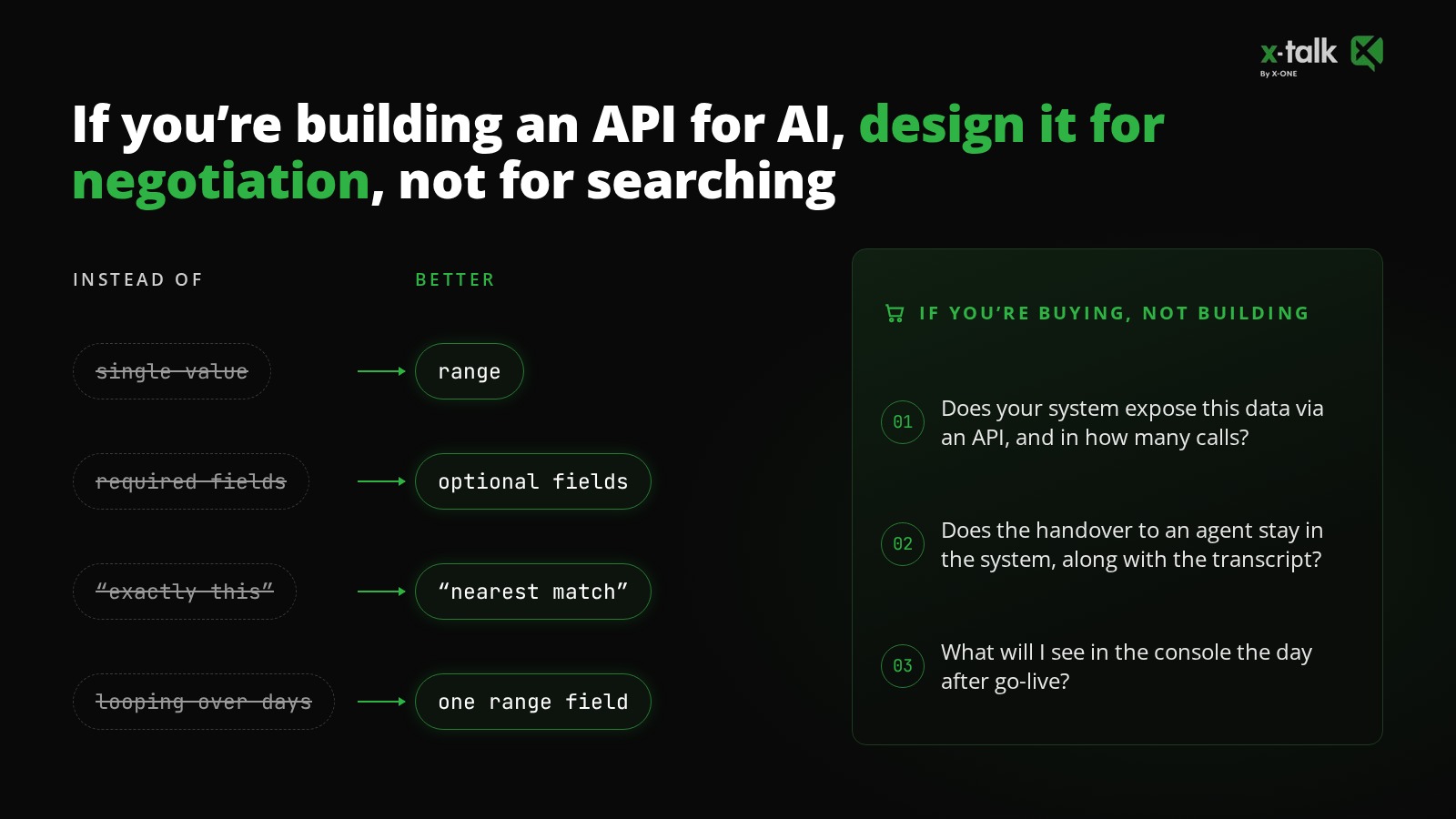
In other words: ranges instead of single values, optional rather than required conditions, and a “nearest match” result instead of “exactly this or nothing”. A single field such as available from, instead of querying the system day by day, saves the bot half the work and half the waiting time.
6. When the bot can’t cope, the conversation is handed over to a human
Not every case can be automated, and not every case should be. What matters is what happens at the moment of handover. The agent shouldn’t start with “Hello, how can I help you?”, but rather with:
“I can see you’re looking for an allergist in Toruń, next week after four o’clock.”
That’s why, along with the call, you need to pass on everything the bot has already established, rather than simply transferring the call. Context, transcript and statistics cover the entire conversation, both the part with the bot and the part with the human. A list of cases handed over to agents, sorted by frequency, then becomes a ready-made list of processes to automate next.
Checklist: appointment-booking dialogue
- The first question is open-ended and encourages the customer to state all conditions at once.
- The bot asks specifically, and only about missing information.
- The bot immediately confirms the understood conditions, while the search runs in the background, in parallel with the conversation.
- The absence of an exact match triggers a broadening of the scope (day → hours → specialist → location → nearest available slot).
- The bot offers 2–3 options, not a list.
- A customer’s refusal is treated as a new condition, not the end of the conversation.
- The bot allows itself to be interrupted and incorporates corrections without starting over.
- Integration with the booking system fits within the time of a natural pause in the conversation.
- Handover to an agent takes place with full context and is measured.
Not just clinics
The same principles apply to any conversation where the customer is looking for something and the system has limited resources — for example, at a car service centre, a service salon, when arranging a technician visit, collecting an order, or booking a room. In all these cases, the quality of a bot is determined by how well it negotiates, not by how nicely it speaks.
At X-ONE, we design and implement voicebots and chatbots for customer service. Our platform is X-TALK - AI Communication Centre. If you’d like to see how a bot negotiates a time slot in practice, book a demo or get in touch with us.
Want to discuss an IT project?
Email us