


What is NLP?
NLP, or Natural Language Processing, is a field of computer science and computational linguistics concerned with the analysis, interpretation and generation of human language by machines. The field of natural language processing – NLP, enables computers to understand and process text and speech in a way that resembles human communication. In this article, however, when using the term “NLP”, we refer exclusively to traditional language processing methods used before the emergence of large language models. This distinction is worth highlighting, as NLP is a broad field encompassing both classic rule-based and statistical methods, as well as modern approaches based on deep learning. LLMs are therefore an integral part of it – the next stage in the development of natural language processing, rather than a separate technology. Classic NLP approaches are based on linguistic rules, statistical models and manually defined features. They make use of, among others, syntactic analysis, tokenisation, n-gram models or classifiers such as Naive Bayes or SVM, which are examples of machine learning applications in NLP.
What is an LLM?
An LLM, or Large Language Model, is an advanced artificial intelligence model trained on vast sets of text data. Unlike traditional NLP methods, an LLM is not based on linguistic rules or manually designed features, but on deep learning – primarily using the transformer architecture and the key attention mechanism. This allows it to analyse a broad context and predict the next word in a sequence of tokens, enabling it to generate coherent text, answer questions, summarise documents or translate languages with previously unmatched effectiveness.
Models such as GPT, BERT or LLaMA are examples of advanced algorithms that use language patterns, which find wide application in text generation, sentiment analysis, speech recognition or supporting virtual assistants. Their operation is based on training data, which allows them to learn dependencies within long sequences of text. Despite their numerous advantages, the challenges of LLMs include, among others, the hardware requirements during training and the risk of perpetuating errors contained in the training data.
In practice, the use of trained LLM models enables the automation of many language-related tasks in real time, opening up new possibilities in the field of natural language processing, such as retrieval augmented generation or the creation of more natural interactions between humans and machines.
Key differences between NLP and LLM
Traditional NLP and LLMs differ both in technical approach and in the scope of their capabilities. Classic NLP relies on manually created rules, syntactic analysis, simple statistical models and dedicated feature engineering. This approach required specialist linguistic knowledge and was difficult to scale. LLMs, on the other hand, learn from vast datasets without the need for manual intervention – they identify dependencies, context and meaning in text on their own. Another difference lies in versatility – LLMs are more flexible and can be applied to various tasks without the need to design separate modules. The quality of results, especially when it comes to context, idioms and ambiguity, also clearly favours LLMs.
Shared challenges for NLP and LLMs
Both traditional NLP and LLMs face similar difficulties, despite differences in approach. One of the main challenges is data bias – models learn from texts created by people, which can lead to the perpetuation of biases. Another issue is the handling of sensitive data – many applications require compliance with privacy and information security rules. Recognising user intent is also difficult, especially in more complex queries. Both NLP and LLMs can also generate responses that seem correct but are factually wrong. Despite advances in machine learning and input data analysis mechanisms, the effectiveness of models still depends on the quality of the data and the context in which they are used, as well as the specific task they are meant to perform.
NLP and LLMs in the context of savings
Both traditional NLP and LLMs can contribute to significant savings – both in time and resources. Classic NLP works well for simple, repetitive tasks such as spam filtering, named entity recognition or sentiment analysis, offering low computational costs and easy integration. LLMs, despite higher hardware requirements, can in turn replace many separate modules with a single versatile model, which simplifies system architecture and reduces the need for extensive engineering. LLMs also make it possible to automate more complex processes, such as content generation or customer service. In the longer term, this can lead to a significant reduction in operating costs, especially in large organisations.
Can LLMs be used without NLP?
Keeping to the terminology used in our article, LLMs are something different from traditional NLP methods; however, in the fullest sense of the term, LLMs are simply a modern stage in the development of NLP. This means that, although it is technically possible to use large language models without directly applying classic techniques, completely ignoring their achievements makes little sense. Traditional methods, such as tokenisation, syntactic analysis, entity recognition and text classification, form the foundation on which modern models are built. What’s more, many systems combine classic approaches with LLMs, creating hybrid solutions that are more precise, faster or cheaper to run. Knowledge of classic NLP makes it possible to better understand the capabilities of LLMs and to use them consciously.
Comparison table – NLP vs LLM
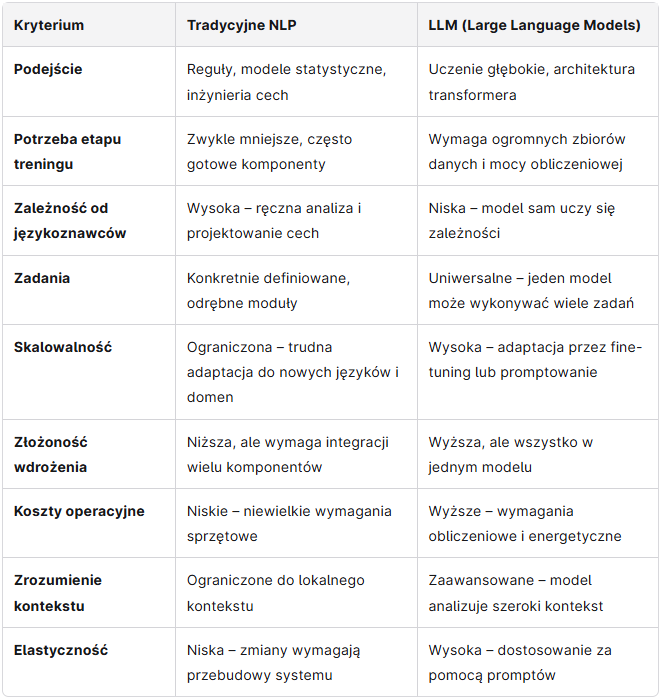
When to use NLP, and when to use LLM?
The choice between traditional NLP and LLM depends on the scale of the project, the resources available and the complexity of the task. Traditional NLP methods work great for simple, repeatable applications such as named entity recognition, information extraction, message classification or sentiment analysis. They are lightweight, fast and inexpensive to implement. LLMs, on the other hand, are worth using when deeper context analysis, multitasking or natural language generation is required – for example in chatbots, automatic content summarisation, translation or document creation. LLMs can also be a better choice where it’s difficult to predict all possible language-use scenarios in advance. In many cases, however, it’s worth considering a combination of both approaches for the best results.
Practical applications of NLP and LLM
Traditional NLP is applied in many stable, well-defined processes. Examples include spam filtering, sentiment analysis of customer reviews, extraction of named entities from text (e.g. companies, locations), document classification, language recognition or automatic metadata completion. These are tasks where rules and statistics work quickly, effectively and at low cost.
LLMs, on the other hand, open up new possibilities thanks to their ability to understand context and generate language. They are used, among other things, in chatbots, voice assistants, machine translation, document summarisation, legal contract analysis, coding, marketing content creation or customer service support. These models make it possible to automate more complex tasks that previously required human intervention or several separate tools.
Want to harness the potential of natural language generation in your business? Get in touch with us and discover how modern artificial intelligence solutions can streamline your processes and help boost efficiency!
Want to discuss an IT project?
Email us